Why there are two Havana Clubs, and why the US only sells one
The Havana Club you can buy in the US isn't the Cuban one. Here's how one rum name split into two rival brands, and why a quiet 2026 deadline could matter.


The Havana Club you can buy in the US isn't the Cuban one. Here's how one rum name split into two rival brands, and why a quiet 2026 deadline could matter.
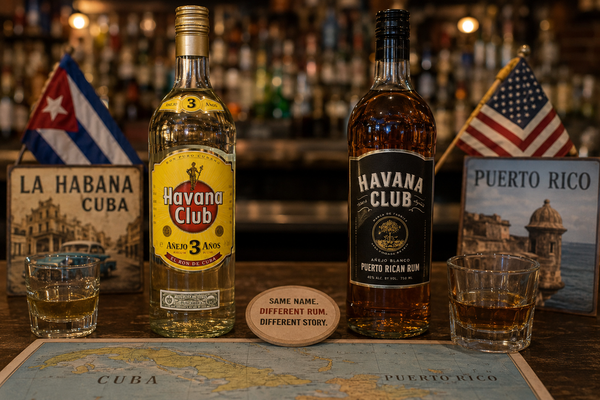
Ask a bartender in Miami and one in Madrid to pour you a Havana Club, and you will get two different rums. Same name, different countries, different owners. That split is the result of a trademark fight between Bacardi and the Cuban government that has run for three decades, and it reached another turning point this summer.
In the United States, the Havana Club on the back bar is a Bacardi product, distilled in Puerto Rico. Almost everywhere else, across more than 120 markets, Havana Club is the Cuban-made rum produced through a joint venture between the Cuban state exporter Cubaexport and the French group Pernod Ricard. It is one of the world's biggest rum brands, selling around 3.1 million cases in 2025. Same name, two companies, separated by a border and an embargo.
The brand was created in Cuba by the Arechabala family in 1934. After the 1959 revolution, the new government nationalized private industry, and the Arechabalas lost their distillery and left the island. In 1973, the family let their US trademark registration lapse. Three years later, in 1976, Cubaexport registered Havana Club in the United States. Two moves in the 1990s set up the modern fight: Cubaexport partnered with Pernod Ricard to build Havana Club into a global brand, and Bacardi bought the Arechabala family's claim to the name and began selling its own Havana Club in the US, arguing that Cuba's seizure of the original business was illegitimate. Cubaexport and Pernod Ricard see it very differently, holding that Cubaexport has been the lawful registered owner of the US mark since 1976, and saying they expect it to survive the challenge.
Here is the strange part: because of the US embargo on Cuban goods, Cuban-made rum cannot legally be sold in the United States at all. Cubaexport cannot sell a single bottle of its Havana Club to an American consumer. So the decades of litigation are not really about today's sales. They are about who owns the name if the embargo is ever lifted, which would open one of the world's largest spirits markets to authentic Cuban rum overnight. That potential prize is what both sides are guarding.
For years, the US registration has seesawed between the two camps. In 2016, after the US Treasury granted a special license, the Patent and Trademark Office renewed Cubaexport's US registration, and Bacardi sued to challenge it. On June 16, 2026, a federal appeals court upheld that renewal, handing Bacardi its latest loss. But the ground has shifted: in December 2024, a new federal law, the No Stolen Trademarks Honored in America Act, barred US agencies from recognizing trademarks confiscated by the Cuban government. Critics have a nickname for it, the "Bacardi Act," a label they also gave the 1998 law that preceded it. The Cuban government condemned the law as an attempt to legitimize the theft of a mark it considers lawfully its own, and John Kavulich of the Cuba-US Trade and Economic Council called it an "immensely cost-effective" lobbying effort for Bacardi, notable for how little opposition it drew in Congress. Its first real test arrived days ago. Cubaexport's renewal application was due June 27, 2026, and Bacardi argues the new law now blocks the trademark office from granting it. As of this writing, whether the office has acted on that filing has not been confirmed, which is exactly why the coming weeks are worth watching rather than calling.
For bartenders and buyers, the practical takeaway is simple: the Havana Club you can legally pour in the United States is Bacardi's Puerto Rican rum, not the Cuban bottling a guest may have tried in London or Havana. That is worth knowing the next time someone asks whether they are drinking the real thing. Either way, Cuban rum's place in cocktail history is not in dispute, from the Daiquiri to the Mojito. More broadly, it is a reminder that what ends up on a label can be shaped as much by politics and history as by what is in the glass. If the trademark question and the embargo ever resolve, the US rum shelf could look very different, very fast.
The next signals are the trademark office's response to the June 27 renewal filing and Bacardi's next move if the registration lapses, either of which could trigger another round of litigation. Until then, the two Havana Clubs remain what they have been for thirty years: one name, two rums, and a border neither can cross.