Inside the first cocktail book: what Jerry Thomas actually put in his 1862 guide
Everyone name-drops the first cocktail book. Far fewer have read it. Here's what Jerry Thomas actually put in his 1862 guide, in his own words.



Everyone name-drops the first cocktail book. Far fewer have read it. Here's what Jerry Thomas actually put in his 1862 guide, in his own words.
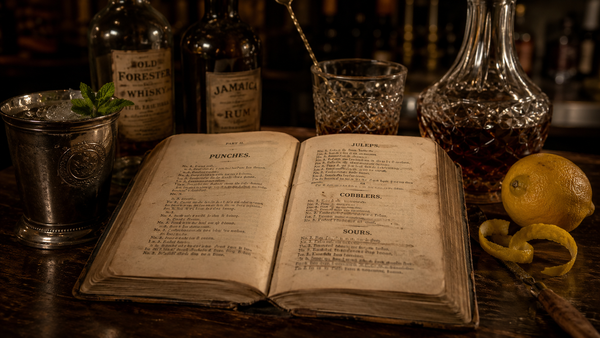
Jerry Thomas's 1862 guide is the most-cited and least-read book in cocktail history. It gets name-dropped on menus, in brand decks, and in origin stories, almost always secondhand, three steps removed from the page. So we went back to the source: the actual 1862 text of The Bar-Tender's Guide, also published as How to Mix Drinks; or, The Bon-Vivant's Companion. Here is what is really in the first cocktail book, in Thomas's own words. (For the man behind it, see our profile of Jerry Thomas, the father of American mixology.)
Published in New York by Dick & Fitzgerald in 1862, it was the first drinks manual of its kind: a single volume that gathered the mixed drinks of America and beyond and told you, precisely, how to make each one. Thomas sorts the recipes into the great families of nineteenth-century drinking, and the introduction boasts of eighty-six kinds of punch alone. Bound in at the back is a second manual, for the manufacture of cordials and syrups, with about four hundred more recipes. Between the two, the book runs to several hundred formulas. It was, in short, an attempt to write down an entire drinking culture before anyone else had bothered.
The guide does not undersell its author. Its introduction calls Thomas "the Jupiter Olympus of the bar" at New York's Metropolitan Hotel, names him the presiding figure at the Planter's House in St. Louis, and notes that he had run celebrated saloons in both New Orleans and New York. It credits him with having "travelled Europe and America in search of all that is recondite in this branch of the spirit art." Some of that is period showmanship, since the book was selling him as much as his recipes, but the résumé was real. By 1862, Thomas was the most famous bartender in the country, and the guide was the proof of his expertise set down in print.
The introduction reads like a manifesto. Thomas declined to moralize about drinking, calling that a question for "the moral philosopher," and argued instead that anyone who could make a drink both palatable and wholesome was "a genuine public benefactor." He had open contempt for careless bartenders, the "villainous compounds of bar-keeping Goths and Vandals," and one unbending rule that any modern bar would recognize: that "no excellent drink can be made out of any thing but excellent materials." He even reached for a little grandeur, borrowing the stage line that there is "philosophy… even in a jug of punch." The book's roll call of period drink names, "Connecticut eye-openers," "Alabama fog-cutters," "lightning-smashes," and "thunderbolt-cocktails," is a reminder of how wild and unrecorded American drinking was before he sat down to organize it.
Much of the book's lasting value is that it maps the categories a nineteenth-century bartender worked in, most of which survive on menus today, sometimes under new names. The essentials:
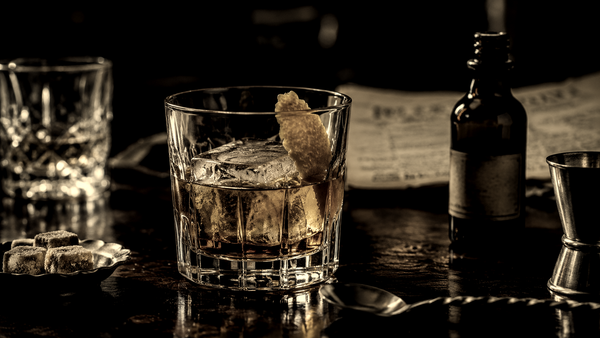
In 1862, the word "cocktail" meant something narrow and specific: a short drink of spirit, sugar, water, and bitters. Thomas gives it its own small section, with a handful of recipes that are among the earliest ever printed, including the Brandy Cocktail, the Fancy Brandy Cocktail, the Whiskey Cocktail, the Gin Cocktail, and the Champagne Cocktail. His Brandy Cocktail is barely recognizable to a modern drinker: brandy stirred with Boker's bitters, gum syrup, and a little curaçao, then served with a twist. It is closer to an Old Fashioned than to almost anything called a "cocktail" on a menu today, which is precisely the point. The word has drifted a long way from where Thomas fixed it, and reading the original definition is the fastest way to see how far.
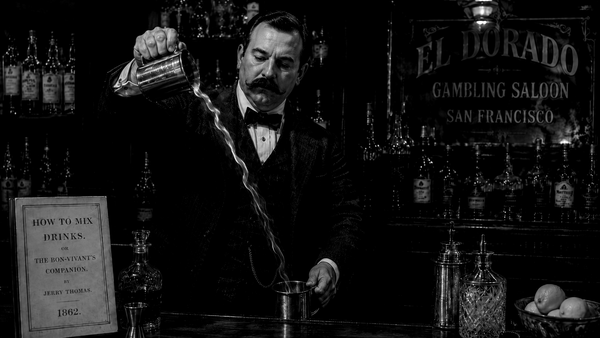
The book's showpiece is the Blue Blazer, the flaming drink that made Thomas famous, and the method is exactly as theatrical as its reputation.
Use two large silver-plated mugs with handles.
Put the whisky and boiling water in one mug, ignite the liquid, and, while blazing, mix the two by pouring the fire four or five times from one mug to the other. Done well, Thomas writes, "this will have the appearance of a continued stream of liquid fire." Sweeten with the sugar and serve in a small bar tumbler with the lemon peel.
Thomas is funny about it, too. He concedes the name is not "very euphonious," says a first-time onlooker might take the drink for "a nectar for Pluto rather than Bacchus," and warns, drily, that "the novice in mixing this beverage should be careful not to scald himself," advising practice "for some time with cold water." It is safety guidance and stagecraft in the same breath, and it tells you how Thomas saw the bar: as a stage where craft and showmanship were the same act.
The book also contains the drink that shares Thomas's name, the Tom and Jerry, a hot, frothy mixture of egg batter, sugar, spirit, and boiling water dusted with nutmeg. The recipe has you beat eggs and sugar to "the consistence of a light batter," then build each serving by the spoonful in a small glass, top it with boiling water, and grate nutmeg over it, with brandy and rum doing the warming.
Thomas is often credited with inventing it, and he claimed it, but the honest history is more tangled. The name "Tom and Jerry" comes from a pair of characters in Pierce Egan's 1821 book Life in London, and hot egg-and-spirit drinks existed before Thomas put his into print. What is fair to say, and what makes this a good lesson in reading origins carefully, is that Thomas popularized the drink and set down a definitive version, not that he conjured it from nothing.
Just as telling is what the 1862 edition does not contain. There is no Martini, no Manhattan, and no Martinez, the drink usually named as the Martini's ancestor. Those arrive later, in the expanded 1887 edition published after Thomas's death. The first edition is a snapshot of American drinking before the cocktail as we know it had fully formed, which is exactly what makes it worth reading rather than merely citing.
For working bartenders, the 1862 guide is not a relic. It is the moment the trade got its first manual, when someone decided that mixing drinks was a craft worth writing down, doing precisely, and taking pride in. Read it, and you see how much has changed: the ingredients, the measures, the very definition of 'cocktail,' and how little has: the insistence on good materials and careful method. Because the first edition is long out of copyright, you do not have to take anyone's word for what is inside it: the full 1862 text is free to read at the Internet Archive. Going to the source is its own lesson. The history of the bar is more interesting, and more accurate, when you read the book instead of the legend.